3 магазини · 0+ продукти

сравнение: Nokian Seasonproof срещу. Michelin CrossClimate 2 (2026)

VS
3 mutual test(s) with detailed data

Michelin stops a car length shorter on dry; Nokian rides quieter and costs meaningfully less.

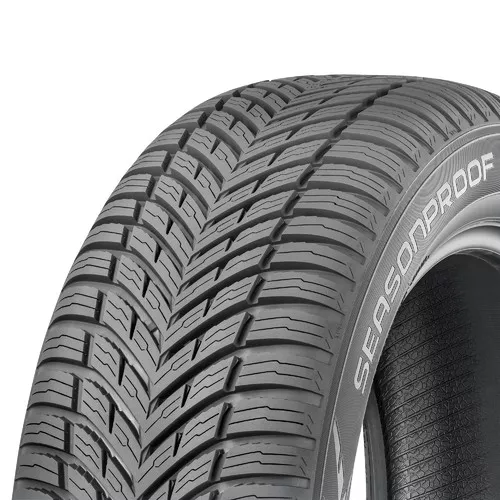
The Nokian Seasonproof is the Finnish brand's bread-and-butter all-season offering, built on a foundation of genuine Scandinavian winter expertise. Covering 41 sizes from R14 to R19, it targets the practical, cost-conscious driver who lives in a genuinely cold climate and wants a single tyre to handle everything from summer motorways to icy side streets. It has since been replaced by the Nokian Seasonproof 1, so today it primarily represents a value buy for those who can still source it — and its character is unmistakable: plush, quiet, and winter-biased, with a comfort-first tuning philosophy that sets it apart from virtually every rival in the segment.

The Michelin CrossClimate 2 occupies a very different position. As the evolution of the original CrossClimate — the tyre that effectively wrote the rulebook for the premium European all-season category — it is Michelin's statement that an all-season tyre need not compromise on dry-road safety or fuel efficiency. Available in 95 sizes up to R21, rated 92/100 by our experts, and backed by a 4.7/5 score from nearly 10,000 owner reviews on Michelin's own platform, it is positioned as a genuinely premium product. Michelin promotes it under the banner of "higher safety levels in all seasons", with a Thermal Adaptive Tread Compound and V-Ramp tread block geometry engineered specifically for short braking distances and maximum ground contact.

Strip away the marketing and one fundamental difference remains: the Nokian is a comfort and winter specialist that trades dry-road braking performance for refinement and cold-weather ability, while the Michelin is a dynamically confident, fuel-efficient all-rounder that trades cabin quietness for shorter stopping distances. In six mutual head-to-head tests the Michelin won four and the Nokian two — but the two categories where the Nokian holds genuine advantages are not trivial ones, and for the right driver they matter enormously.

Nokian Seasonproof
подходяща за
Long-distance comfort-first motorway drivers Cold-climate drivers needing strong winter traction Budget-conscious all-season buyers Drivers sensitive to cabin noise and ride quality
не е идеална за
Drivers who prioritise short dry stopping distances Performance or sporty driving styles High-mileage users focused on running costs
Michelin CrossClimate 2
подходяща за
Safety-conscious drivers prioritising dry braking Fuel economy-focused highway commuters Mixed-climate drivers wanting dynamic all-round confidence Premium car owners unwilling to compromise on grip
не е идеална за
Noise-sensitive or comfort-first passengers Budget-conscious buyers watching cost per kilometre Drivers mainly in deep winter or Scandinavian conditions

Test profile

Nokian
Seasonproof
Michelin
CrossClimate 2
Брой тестове
7
25
Best position
#3
#1
Average position
7.4
2.7
най-нов тест
2022
2026
налични размери
57
157

сравнение на представянето

средно от 3 теста

представяне на мокро
Confidence
Nokian Seasonproof
71%
Nokian
Seasonproof
Michelin CrossClimate 2
75%
Michelin
CrossClimate 2
спиране на мокра настилка
Nokian Seasonproof
64%
Michelin CrossClimate 2
72%
мокра обработка
Nokian Seasonproof
54%
Michelin CrossClimate 2
75%
Завиване в мокър кръг
Nokian Seasonproof
79%
Michelin CrossClimate 2
74%
аквапланинг по дължина
Nokian Seasonproof
77%
Michelin CrossClimate 2
84%
аквапланинг при странично движение
Nokian Seasonproof
79%
Michelin CrossClimate 2
72%

Switch to wet asphalt and the competitive picture narrows considerably. Across 2 measured wet braking tests, the Michelin CrossClimate 2 averaged 51.6 metres and the Nokian Seasonproof averaged 53.0 metres — a gap of just 1.4 metres, a fraction of the dry-road difference. More strikingly, the result reverses depending on tyre size: on 195/55 R16 the Michelin held a 3.2-metre edge (49.2m vs 52.4m), but on 225/50 R17 the Nokian actually stopped 0.4 metres shorter (53.5m vs 53.9m). Neither tyre dominates wet braking reliably, and the wet-braking performance scores — Nokian 62.5, Michelin 75.3 — reflect averages across a broader test history that still favour Michelin, but less emphatically than on dry roads. Both tyres also share a tendency toward understeer in wet cornering, an inevitable consequence of all-season compound compromises.

Aquaplaning resistance is a category where the Nokian punches back, scoring 79.2 versus Michelin's 76.7. Breaking that down further, the Nokian leads on cross aquaplaning (81.8) while its longitudinal score of 76.7 is identical to Michelin's overall aquaplaning mark — suggesting Nokian's tread geometry is particularly effective at channelling water away in lateral flooding scenarios, such as wet motorway lane changes. Michelin, despite slight aquaplaning weaknesses flagged by testers on multiple occasions, counters with a wet-handling-objective score of 92.5 — excellent for an all-season — which means its cornering confidence and lateral stability in the wet are better controlled than the Nokian's once speed and cornering load increase beyond the aquaplaning threshold.

The overall wet picture is close enough that driver confidence and surface type matter as much as raw test numbers. In sustained heavy rain and standing water, the Nokian's aquaplaning edge provides genuine reassurance; in fast wet corners and emergency situations on soaked but drainable asphalt, the Michelin's wet-handling objectivity and superior average wet-braking record give it the edge. Both tyres carry a B wet-grip EU label rating across their full size ranges — the same grade — so on paper they are equivalent at point of purchase, but the test detail tells a more differentiated story.

представяне на сухо
Confidence
Nokian Seasonproof
70%
Nokian
Seasonproof
Michelin CrossClimate 2
92%
Michelin
CrossClimate 2
сухо спиране
Nokian Seasonproof
66%
Michelin CrossClimate 2
97%
обработка в сухо състояние
Nokian Seasonproof
73%
Michelin CrossClimate 2
86%

Dry braking is where the gap between these two tyres is at its widest and its most safety-relevant. Averaged across 2 measured braking tests, the Michelin CrossClimate 2 stops in 38.8 metres versus the Nokian Seasonproof's 43.9 metres — a deficit of 5.1 metres. At typical road speeds that translates to just over one full car length of additional stopping distance every single time the driver makes an emergency stop. In the most forensic direct comparison available — a 35-tyre braking shootout on 195/55 R16 — Michelin recorded 39.9m against Nokian's 46.3m, a 6.4-metre gap that placed the Nokian 15th and the Michelin 3rd. These are not marginal differences; they represent a meaningful and repeatable safety gap on the surface where most driving occurs.

The reason lies in compound and construction priorities. Michelin's V-Ramp tread blocks are engineered to maximise contact patch area under hard longitudinal braking loads, and the Thermal Adaptive Compound stays sufficiently firm at ambient temperatures to deliver high grip coefficients on dry asphalt. The result is a dry-braking performance score of 91.6 — versus the Nokian's 68.3. Interestingly, the Nokian's dry-handling-objective score of 96.5 is fractionally higher than Michelin's 96.3, which tells you that its chassis balance and steering response at moderate cornering loads are genuinely good. The problem is not mid-corner composure; it is the absolute limit of adhesion under emergency braking, where the Nokian's softer, comfort-optimised compound cannot generate the same deceleration forces. Testers flagged understeer tendencies in dry handling on both axes, but the Nokian's bias toward a relaxed, slightly understeering character compounds its braking weakness at higher speeds.

One nuance worth preserving: in the Autobild 2022 full comparative test on 195/55 R16 — where braking was one component among many — the Nokian finished 6th out of 15 while the Michelin came 9th. Similarly, in the Autobild 2021 225/50 R17 overall ranking, Nokian placed 6th and Michelin 7th. This confirms that when balanced against handling, aquaplaning and comfort, the Nokian is not outclassed overall — but for any driver who regards stopping distance as the primary safety metric, the Michelin's 5.1-metre average advantage on dry roads is decisive.

представяне на сняг
Confidence
Nokian Seasonproof
90%
Nokian
Seasonproof
Michelin CrossClimate 2
91%
Michelin
CrossClimate 2
спиране при сняг
Nokian Seasonproof
93%
Michelin CrossClimate 2
90%
сцепление със снега
Nokian Seasonproof
91%
Michelin CrossClimate 2
97%
обработка на снега
Nokian Seasonproof
93%
Michelin CrossClimate 2
87%
завиване в кръг на сняг
Nokian Seasonproof
84%
Michelin CrossClimate 2
91%

Snow performance is where both tyres earn their 3PMSF severe-weather certification most convincingly — and where the Nokian's Scandinavian heritage becomes a genuine differentiator. Overall snow scores run Michelin 92.3 versus Nokian 89.6, a 2.7-point gap in the Michelin's favour. But the sub-metric breakdown is revealing: Nokian's average snow-braking test score of 93.0 actually exceeds Michelin's 89.5, and it records 91.5 for snow acceleration, 87.2 for snow traction, and 85.0 for snow circle cornering. These are the metrics that define real-world winter usability — getting away from standstill on a glazed hill, stopping before an icy junction, managing traction on packed compacted snow. Nokian's decades of cold-climate development at its Ivalo, Finland test facility, which celebrated its 40th anniversary in early 2026, produce measurable results in these areas.

Where the Michelin truly separates itself is in snow handling composure. A snow-handling-objective score of 98.5 — the highest figure in this dataset — backed by 95.0 measured and 92.8 in circle cornering, reflects a tyre that stays composed and controllable at the limits of adhesion on snow-covered roads. Michelin's Thermal Adaptive Compound keeps the rubber sufficiently pliable in sub-zero temperatures to maintain grip through long, fast corners on compacted snow, and its step-on-block tread geometry provides the mechanical interlocking with snow crystals that generates traction from the tyre's own structure. Multiple independent tests concluded that the CrossClimate 2 outperformed a dedicated winter tyre in snow conditions — a remarkable achievement, and one that validates Michelin's claim of "higher safety levels in all seasons".

In practice, both are serious winter performers that will leave any summer tyre comprehensively outclassed when temperatures drop below 7°C. The Nokian wins when you need to brake hard or pull away on compacted snow; the Michelin wins when you need to hold a line through a fast snowy bend. Drivers in Scandinavia or mountain regions who spend significant time on packed snow at lower speeds will appreciate the Nokian's traction and braking credentials; drivers who traverse Alpine passes or need confident high-speed winter handling will be better served by the Michelin's exceptional snow cornering scores.

комфорт и шум
Confidence
Nokian Seasonproof
82%
Nokian
Seasonproof
Michelin CrossClimate 2
84%
Michelin
CrossClimate 2
външен шум
Nokian Seasonproof
89%
Michelin CrossClimate 2
87%
комфорт при шофиране
Nokian Seasonproof
75%
Michelin CrossClimate 2
80%

Comfort and noise is the domain in which the Nokian Seasonproof doesn't just win — it wins emphatically. Its comfort score of 94.6 against Michelin's 73.0 represents a 21.6-point gap, and its noise score of 95.5 against Michelin's 69.4 represents a 26.1-point gap. These are not statistical artefacts; they describe a fundamentally different cabin experience across every road surface. The Nokian's soft compound and compliant carcass absorb surface imperfections and damp road roar to a degree that drivers notice immediately. On Heureka, 34 verified buyers awarded it 9.4/10, with low noise cited eight times and great value mentioned equally frequently — the highest mention counts among all listed pros. A Volvo V90 D4 owner who covered 40,000–45,000 miles across the UK and Europe over three-plus years described the ride as consistently refined throughout the tyre's life. By contrast, even satisfied CrossClimate 2 owners acknowledge a slightly firmer, slightly louder character — the inevitable consequence of the stiffer sidewall and higher-durometer compound that generate its dry-grip advantage.

Running costs split the verdict in the opposite direction. Michelin's rolling resistance score of 87.2 is 11.7 points higher than Nokian's 75.5 — a gap validated by independent testing that recorded the CrossClimate 2 achieving the lowest wear rate and lowest rolling resistance in its test field, with correspondingly superior fuel-saving potential. Michelin's EU fuel label spans A through C across its size range, with a meaningful proportion of sizes achieving B and even A ratings. The Nokian's entire 41-size range sits at C. Over 20,000 kilometres per year, the rolling resistance advantage translates to a tangible annual fuel saving that chips away at Michelin's higher purchase price. Mileage scores are closer — Michelin 77.4, Nokian 74.5 — and both manufacturers predict reasonable tyre life, though independent testing placed Michelin as the lowest-wear tyre in at least one major evaluation.

That purchase price remains Michelin's most consistent vulnerability. Multiple test panels flagged the CrossClimate 2 as the most expensive tyre in its comparison group, and the combination of a premium price with only average tread life makes the per-kilometre running cost high — a point reinforced by real owners. The Nokian brand's value positioning is straightforward: the Seasonproof costs less upfront, rides quieter, absorbs bumps better, and owners report satisfaction after substantial mileage. One fleet manager running multiple vehicles across all major all-season brands rated the Nokian highly after 20,000 miles on a Skoda, calling its real-world performance superior to several more expensive rivals. Worth noting: the Nokian Seasonproof has been succeeded by the Nokian Seasonproof 1, and buyers should investigate that updated model before committing — if it addresses the original's braking weaknesses while retaining its comfort credentials, it could be a more compelling proposition still.

икономия
Confidence
Nokian Seasonproof
71%
Nokian
Seasonproof
Michelin CrossClimate 2
70%
Michelin
CrossClimate 2
съпротивление при търкаляне
Nokian Seasonproof
66%
Michelin CrossClimate 2
84%
пробег
Nokian Seasonproof
75%
Michelin CrossClimate 2
56%

графика на представянето (паяк)

заключение

For the majority of drivers in central and western Europe, the Michelin CrossClimate 2 is the stronger, safer, and more complete all-season choice. Its 5.1-metre average dry braking advantage across 2 measured tests is the headline, but the full picture is even more persuasive: superior snow handling composure, better rolling efficiency, a 92/100 expert rating, and four wins from six head-to-head tests against the Nokian. Michelin positions it as delivering "higher safety levels in all seasons" and the independent data largely validates that claim. Owners confirm the experience — a Ford Focus MK3 driver switching from conventional all-seasons described the CrossClimate 2 as a night-and-day difference in snow and slush, while noting the quiet, confident dry-road character. For any driver who regards outright safety margins as non-negotiable, and particularly for those covering mixed conditions in temperate climates, the Michelin is the clear recommendation. Its higher Michelin premium is real, but it is a premium paid for a genuinely exceptional tyre.

The Nokian Seasonproof makes a compelling case for a specific kind of driver — and that driver deserves to know exactly what they are getting. If your commute involves long motorway stretches where cabin refinement matters more than last-metre braking performance, the 26-point noise advantage and 21-point comfort advantage are not numbers on a spreadsheet; they are the difference between an exhausting daily drive and a relaxing one. Its aquaplaning resistance edge, superior snow braking, and snow traction scores are genuine cold-climate credentials, and at a lower purchase price it offers outstanding value in those metrics. The caveat is firm: its dry braking deficit is consistent and substantial, and drivers who need to moderate their following distances and approach speeds in dry conditions to compensate for the softer compound are not imagining things.

Buy the Michelin CrossClimate 2 if you drive in mixed to moderate winter conditions, value short stopping distances, cover motorway kilometres where fuel costs matter, or simply want the best-rounded all-season tyre currently available regardless of price. Choose the Nokian Seasonproof — or its successor, the Nokian Seasonproof 1 — if your driving is dominated by cold, snowy conditions, you spend long hours on comfortable cruising roads rather than in dynamic situations, and you want the quietest, most refined all-season cabin experience available at a sensible price. Both tyres are 3PMSF certified and both are credible all-season choices; the difference is one of character, and the right character depends entirely on how and where you drive.
тестове, използвани в сравнението

организациясезонгодинаразмер
AutobildAutobild
всесезонни
2022195/55 R16преглед
Autoklub ČRAutoklub ČR
всесезонни
2022205/55 R16преглед
AutobildAutobild
всесезонни
2021225/50 R17преглед

размери и цени

сравнете цените за всички налични размери на тези гуми.

размер Nokian Seasonproof Michelin CrossClimate 2 %
205/55 R16
205/55 R16
205/55 R16
205/55 R16
205/55 R16
виж общото сравнение

добавете към сравнението

Popular brands
ново сравнение

GumiLab.eu

ВЗЕМИ

GumiLab.eu

Сравнете гуми, прочетете тестови резултати и намерете най-добрите цени — всичко в едно приложение.
